Yunhua Liao, Shizhong Lu and Feihu Yu
Nanjing Kerun Industrial Media Co., Ltd.
Jiangning, Nanjing 211100, China
Abstract: This study evaluates how inhibitor molecular structure affects corrosion protection of ADC12 aluminum alloy in water-based cutting fluids. Seven phosphorus-containing inhibitors, including phosphate esters and an alkylphosphonic acid, were compared in purified water, standard calcium/magnesium hard water and aluminum-ion-containing water. Full-immersion tests and electrochemical impedance spectroscopy were used to assess protection, while scanning electron microscopy and energy-dispersive X-ray spectroscopy were used to examine surface morphology and elemental composition after exposure. Branched-chain alkyl phosphate esters provided effective protection of ADC12 under the conditions studied. Both calcium/magnesium hardness and elevated aluminum-ion loading reduced inhibition performance, with the extent of deterioration depending on inhibitor structure. The findings highlight the importance of molecular structure and dilution-water chemistry when selecting inhibitors for aluminum machining fluids.
Keywords: phosphate esters; aluminum alloy; cutting fluids; corrosion inhibitors
Introduction
Aluminum alloys are widely used in machinery, transportation, chemical packaging and household products because of their low density, approximately one-third that of steel, together with favorable physical, mechanical and corrosion-resistance properties and ease of processing. In the automotive sector, increasingly demanding fuel-economy and emissions requirements have encouraged greater use of aluminum. This creates demand for metalworking fluids that can machine aluminum as well as other materials, including steel and copper. A key challenge is to minimize staining on the finished aluminum components [1].
ADC12 is widely used for components such as engine blocks, cylinder heads and motor covers or housings because of its favorable casting characteristics and suitability for high-volume production. Its alloying constituents, including zinc, copper and magnesium, influence its corrosion behavior, and its intrinsic corrosion resistance is limited. A feature published by the Society of Tribologists and Lubrication Engineers identifies three causes of aluminum corrosion and staining in water-based metalworking fluids [2]. First, alkaline conditions can dissolve the protective oxide layer, producing discoloration ranging from pale yellow to dark gray. Second, galvanic corrosion can occur when aluminum contacts a dissimilar metal in an aqueous environment; for example, aluminum in contact with a cast-iron or steel machine bed may corrode preferentially. Third, elevated chloride concentrations in the process water increase the risk of staining.
Chloride-containing environments can cause substantial corrosion of aluminum and its alloys [3], particularly pitting, which limits their application [4]. Corrosion inhibitors can improve resistance [5] by interacting with the metal through functional groups, π-electron systems or heterocyclic structures to form adsorbed protective films [6]. Phosphate esters are used as effective aluminum corrosion inhibitors in water-based cutting fluids, including formulations for susceptible alloys such as 7075 [7]. Their structures vary widely, however, and selecting suitable products requires an understanding of both protection and failure mechanisms. This study compares seven inhibitors on ADC12 and simulates the accumulation of calcium, magnesium and aluminum ions during cutting-fluid service.
1 Experimental Materials
The materials comprised a semi-synthetic cutting-fluid base formulation; standard calcium/magnesium hard water at 100, 300 and 500 mg/L; aluminum-ion-containing test water at nominal levels of 200, 300, 400 and 500 mg/L; purified water with conductivity below 20 μS/cm; and standard ADC12 aluminum test specimens.
The inhibitor products were Hordaphos MDIT (MDIT), a branched-chain alkyl phosphate ester from Clariant used for aluminum and zinc protection; ADDCO CP-NF-3 (CP-NF-3), a branched-chain alkyl phosphate ester from Lubrizol used for nonferrous-metal protection; Phospholan PE169 (PE169), an alkyl ethoxylate phosphate ester from Akzo; Rhodafac ASI80 (ASI80), an alkylphosphonic acid from Solvay used for aluminum, zinc and magnesium protection; Lubrhophos LB-400 (LB400), an alkyl ethoxylate phosphate ester from Solvay; Rhodafac PA24 (PA24), an alkyl ethoxylate phosphate ester from Solvay; and PZ, a laboratory-synthesized branched-chain alkyl phosphate ester.
2 Experimental Methods
2.1 Test Fluid Preparation
Standard calcium/magnesium hard water was prepared at hardness levels of 100, 300 and 500 mg/L expressed as CaCO₃. Aluminum-ion-containing water was prepared at nominal levels of 200, 300, 400 and 500 mg/L expressed on an aluminum nitrate basis. The semi-synthetic cutting-fluid base formulation is shown in Table 1.
Table 1 Semi-synthetic cutting-fluid base formulation
| Component | Content wt% |
| Organic amines | 5-15 |
| Rust and corrosion inhibitors | 2-5 |
| No. 22 naphthenic base oil | 35 |
| Lubricity additives | 3-5 |
| Emulsifiers | 5-10 |
| Coupling agents | 1-5 |
| Biocides | 2-5 |
| Water | Balance |
2.2 Full Immersion Corrosion Testing
Each inhibitor was incorporated separately into the base formulation at 2% by mass. The resulting concentrates were diluted to 5% by mass using purified water, standard hard water at 100, 300 or 500 mg/L, or aluminum-ion-containing water at 200, 300, 400 or 500 mg/L. Prepared ADC12 specimens were fully immersed in the test fluids, the vessels were covered with watch glasses, and the tests were conducted in a temperature-controlled oven at 55 ± 2 °C. Surface corrosion and staining were assessed after 2, 4 and 8 h.
The rating criteria followed GB/T 6144: Grade A, no visible corrosion and a bright surface comparable to a new specimen; Grade B, slight darkening; Grade C, moderate darkening; and Grade D, severe darkening.
2.3 Electrochemical Testing
A sectioned cylindrical aluminum specimen mounted in epoxy resin served as the working electrode. The exposed surface was ground sequentially with abrasive papers up to 2000 grit. Grinding marks were aligned in one direction to minimize variability arising from surface preparation. A platinum plate was used as the counter electrode and an Ag/AgCl electrode as the reference. Electrochemical impedance spectroscopy (EIS) was performed with a CHI660E workstation at the open-circuit potential (OCP), using a 5 mV perturbation amplitude. Each inhibitor was added to the base formulation at 2% by mass, and the concentrate was diluted to 5% with purified water. The electrode was immersed in the diluted fluid for impedance measurement.
2.4 Surface Analysis
Scanning electron microscopy (SEM) and energy-dispersive X-ray spectroscopy (EDS) were used to examine surface morphology and elemental composition after corrosion testing.
3 Results and Discussion
3.1 Full Immersion Test Results
Table 2 compares protection in purified water. MDIT, CP-NF-3 and PZ have similar branched-chain alkyl phosphate ester structures and provided effective protection of ADC12: all three were rated A after 2 and 4 h and B after 8 h. Their performance is consistent with the formation of a relatively compact protective film. ASI80, an alkylphosphonic acid, maintained Grade A throughout the 8 h test, consistent with favorable surface adsorption and formation of a hydrophobic film. The alkyl ethoxylate phosphate esters PE169, PA24 and LB400 provided less protection. The ethoxylate segments increase hydrophilicity and may introduce steric effects that hinder formation of a continuous hydrophobic film. LB400 performed best within this group, which the study attributes to its longer hydrophobic alkyl chain and greater surface coverage.
Table 3 shows that standard hard water reduced the protection provided by all seven inhibitors. MDIT, CP-NF-3 and PZ were relatively tolerant of hardness: at 300 mg/L as CaCO₃, their ratings were A at 2 h and B at 4 and 8 h. Their branched structures may help retain sufficient active inhibitor to form a protective film. At 500 mg/L, all three deteriorated to Grade C after 4 h and Grade D after 8 h, indicating a limit to this tolerance under the test conditions. ASI80 was more sensitive, reaching Grade D after 4 h at 300 mg/L. This behavior is consistent with reduced film stability in hard water for the alkylphosphonic acid structure evaluated.
Table 4 shows that MDIT, CP-NF-3 and PZ also performed comparatively well in aluminum-ion-containing water, although elevated aluminum loading substantially reduced their protection. The other four inhibitors followed trends broadly similar to those observed in calcium/magnesium hard water. Aluminum machining generates large quantities of reactive chips, creating a source of dissolved aluminum in the working fluid. Using purified dilution water limits calcium and magnesium input but does not prevent aluminum accumulation. The results therefore indicate that even fluids prepared with purified water may lose aluminum protection during prolonged service as aluminum loading increases, creating a risk of staining.
Table 2 Corrosion ratings of ADC12 specimens in fluids prepared with purified water
| Inhibitor | MDIT | CP-NF-3 | PE169 | ASI80 | LB400 | PA24 | PZ |
| pH | 9.1 | 9.1 | 9.2 | 9.1 | 9.2 | 9.2 | 9.1 |
| ADC12 | A A B | A A B | B C D | A A A | B B B | C D D | A A B |
Within each rating cell, the results are listed for 2 h, 4 h and 8 h, from top to bottom. A = no visible corrosion; B = slight darkening; C = moderate darkening; D = severe darkening.
Table 3 Corrosion ratings of ADC12 specimens in fluids prepared with standard hard water
| Inhibitor | MDIT | CP-NF-3 | PE169 | ASI80 | LB400 | PA24 | PZ |
| pH | 9.1 | 9.1 | 9.2 | 9.1 | 9.2 | 9.2 | 9.1 |
| 100 mg/L | A A B | A A B | B C D | A B B | B B B | C D D | A A B |
| 300 mg/L | A B B | A B B | C C D | C D D | B C D | D D D | A B B |
| 500 mg/L | B C D | B C D | D D D | D D D | D D D | D D D | B C D |
Within each rating cell, the results are listed for 2 h, 4 h and 8 h, from top to bottom. A = no visible corrosion; B = slight darkening; C = moderate darkening; D = severe darkening. Hardness is expressed as CaCO₃.
Table 4 Corrosion ratings of ADC12 specimens in fluids prepared with aluminum-ion-containing water
| Inhibitor | MDIT | CP-NF-3 | PE169 | ASI80 | LB400 | PA24 | PZ |
| pH | 9.1 | 9.1 | 9.2 | 9.1 | 9.2 | 9.2 | 9.1 |
| 200 mg/L | A A B | A A B | C C D | A B B | B B B | C D D | A A B |
| 300 mg/L | B B B | B B B | C D D | C D D | C D D | D D D | B B B |
| 400 mg/L | B B D | B B D | D D D | D D D | D D D | D D D | B B D |
| 500 mg/L | B C D | B C D | D D D | D D D | D D D | D D D | B C D |
Within each rating cell, the results are listed for 2 h, 4 h and 8 h, from top to bottom. A = no visible corrosion; B = slight darkening; C = moderate darkening; D = severe darkening. Nominal concentrations are expressed on an aluminum nitrate basis.
3.2 Electrochemical Impedance Analysis
The impedance arcs were reported to have similar shapes for the different inhibitors, suggesting broadly similar electrochemical response mechanisms. In purified water, ASI80 produced the largest arc radius, consistent with the strongest inhibition and formation of a compact adsorbed layer. This agreed with the full-immersion results. PZ, MDIT and CP-NF-3 produced similar arc radii and comparable protection. Differences among PA24, LB400 and PE169 were associated with their alkyl-chain lengths and ethoxylate structures. Longer hydrophobic alkyl chains were associated with better inhibition, with performance ranked LB400 > PE169 > PA24.
3.3 Surface Analysis of ADC12
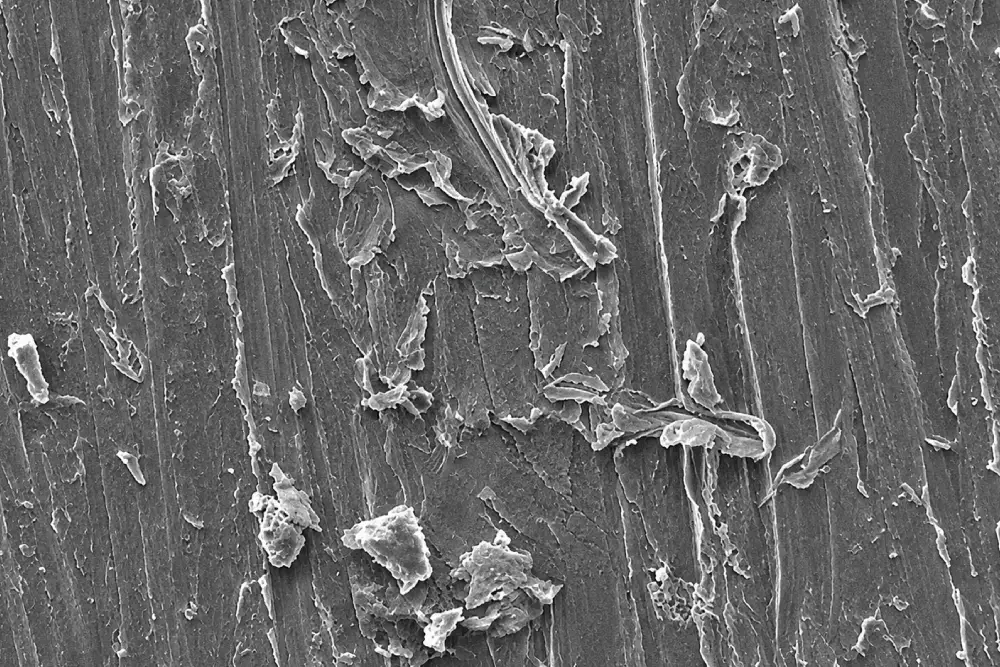
Figure 1 and Table 5 present the surface morphology and EDS results for ADC12 after 8 h in the PA24-containing fluid prepared with purified water. The SEM observations described in the study showed grinding marks and pitting. The relatively high oxygen content was consistent with surface corrosion. The presence of carbon was interpreted as evidence of an adsorbed organic layer; however, the observed pitting suggests that this layer did not provide complete protection.
Figure 2 and Table 6 present the corresponding results for CP-NF-3 after 8 h in purified-water-based fluid. The flake-like surface features, together with higher carbon and lower oxygen contents than those measured for PA24, were interpreted as consistent with a more protective adsorbed layer that limited alkaline attack. The study attributes this behavior to branching near the end of the alkyl chain, which may improve hard-water tolerance without introducing excessive intermolecular steric hindrance. Such a structure can favor a compact hydrophobic layer and retain protection under some hard-water conditions. MDIT and PZ showed similar inhibition behavior; small differences among the three products may reflect differences in raw materials or synthesis.
The surface observations support a relationship between inhibitor structure, adsorbed-film coverage and corrosion protection. More complete protective coverage is associated with less attack and reduced staining. SEM morphology and elemental composition support this interpretation but do not, by themselves, uniquely identify the molecular structure of the surface film.
Figure 1 ADC12 surface after 8 h in PA24-containing fluid prepared with purified water
Table 5 EDS elemental composition of the ADC12 surface after exposure to PA24-containing fluid
Summed spectrum from the mapped area.
| Element | Line family | Weight % | Weight % sigma | Atomic % |
| O | K series | 34.22 | 0.29 | 43.07 |
| Al | K series | 52.23 | 0.37 | 38.98 |
| Si | K series | 2.30 | 0.06 | 1.65 |
| Mg | K series | 0.46 | 0.03 | 0.38 |
| Fe | K series | 0.87 | 0.06 | 0.32 |
| C | K series | 9.14 | 0.56 | 15.32 |
| Cr | K series | 0.37 | 0.04 | 0.15 |
| Ca | K series | 0.13 | 0.02 | 0.07 |
| Cu | K series | 0.26 | 0.07 | 0.08 |
| Total | 100.00 | 100.00 |